


The Books of the Raqs Sharqi Museum

There is a particular kind of excitement that comes with finding a book that no many people in our dance field know exists.
Not a famous biography, not something you can easily order online. A small, worn volume that somehow ended up with a collector, or surfaced through an antique dealer's catalogue — and that carries inside it a piece of the (hi)story I have been trying to piece together for six years.
The Raqs Sharqi Museum is mostly known for photographs, engravings, vinyl records, postcards, and many more. But alongside all of that, I have also been collecting books. Not many — but true treasures. Here I want to introduce you to six of them, with some basic description and a few pages of translation.

Tahia Carioca and the Most Famous Dancers of Egyptian Cinema
Mohamed El-Sawy
Dar Al-Ratib Al-Jami'iya
Beirut, 1995
This one is not findable online, as far as I know (please, if you are aware of its online existance, let me know). It exists in Arabic, and it came to me through a contact in Cairo. And as far as I can tell it is one of those books that simply never made it into the digital world. Which is exactly why it matters to me.
Written in a warm, nostalgic style, it centres on Tahia Carioca — one of the most iconic dancers and actresses of Egypt's Golden Age of cinema. It places her within the social landscape of Cairo, within the world of Egyptian cinema, within the broader constellation of dancers and performers who defined that time. It includes filmography, cultural reflection, personal detail. The kind of book that was written for Egyptian readers who already loved her — not for outsiders trying to understand her from a distance.
Tahia began her career under the wing of Badia Masabni — the ultimate influencer of her time, whose entertainment halls such as Saala Badia and Casino Opera launched many careers of dancers, singers, musicians, and composers. From there she became something larger than a dancer and an actress. She became a symbol of courage, Egypt as a homeland, and true bint el-balad. She was vocal about her political opinions, was jailed for them more than once, and was loved precisely because she never stopped being exactly who she was.
I find books like this one important precisely because they are not documented. Hopefully, I will be, one day, able to provide a full translation. But until then, here you have a short translated excerpt:


Koutchouk-Hanem, l'Almée de Flaubert, suivie de onze essais sur la vie de Flaubert et sur son œuvre
Auriant
Mercure de France
Paris, 1943
This one is well documented — it is catalogued at the Bibliothèque nationale de France, it appears occasionally with rare book dealers, it is cited in academic writing on Flaubert and Orientalism. But it is still not easy to find, and very few people in the dance world know it.
Auriant was the pseudonym of Alexandre Hadjivassiliou, and his subject is Koutchouk-Hanem — the Egyptian almée encountered by Gustave Flaubert in Esneh in 1850. Flaubert wrote about her obsessively in his travel notes and letters. She fascinated him completely. And Auriant's book reconstructs her identity as carefully as the available sources allow, while also including eleven essays on Flaubert's life and literary work — which gives the book a broader scope than the title suggests.
For me, the value of this book is that it contains one of the earliest detailed Western descriptions of Egyptian dance. Not raqs sharqi as we know it — this is decades before the Golden Era, before cinema, before any of that. This is dance as it existed in 19th-century Egypt, described by a French writer who clearly could not believe what he was seeing.
But reading it, you also have to hold the other thing in mind: Flaubert saw Koutchouk-Hanem through his own projections. He saw what he came to Egypt wanting to see. Auriant is aware of this, and navigates it thoughtfully. The book is both a historical source and a document of how deeply Orientalism distorted the Western perception of Egyptian dance and Egyptian people — reducing real human beings to props in someone else's fantasy of the Orient.
Here are a few exerpts:


Shafiqa al-Qibtiyya: The Truth About the Ghajariyah
Jamil al-Bandari
1960' (?)
This book may well be documented in Arabic sources, but in the English-speaking world it simply does not exist. It came to me through a contact in Cairo.
It tells the story of Shafiqa El Koptiya, one of the most famous Egyptian dancers of the late 19th and early 20th centuries. She rose to extraordinary wealth and fame. A 1963 biopic film was made about her life (possibly based on this book, or this book is based on the movie) — but as always, the myth eventually overtook the possibly true story.
The book opens with a remarkable detail: that King Farouk once commissioned a confidential report comparing three women — Nazli, Shweikar, and Shafiqa al-Qibtiyya — and the conclusion was that Shafiqa was ahead of her time, the first woman of the common people to challenge authority. I have not been able to verify this independently. But it captures something real about how she was perceived — and how unusual she was.
The writing is vivid and deeply Cairene. The abandoned house on Nakhla Street with the stories whispered about it. The morning she walks down the street and stops all conversation. It reads like oral history written down before it could disappear. Let’s read a short excerpt here, together:


Samia Gamal: The Butterfly
Nahed Salah
Masr Al-Arabia for Publishing & Distribution, 2017
This is the most recent book in the collection, written by Egyptian film critic Nahed Salah. Her subject is the famous Samia Gamal. (Did you know that the Raqs Sharqi Museum has already 4 of her photos signed by her?)
What I find valuable about this book is that it refuses to turn Samia into a monument. It says plainly: this is not a history of dance. This is the story of a woman. And it means that — it follows her through early deprivation, through emotional wounds, through the contradictions of being enormously famous in a world that wasn't sure whether to admire or condemn her.
The phrase that stayed with me, from the introduction: she did not resist change — she transformed through it. Anyone who has ever watched Samia Gamal dance will understand immediately what that means.


The World's Fair: Being a Pictorial History of the World's Columbian Exposition
William E. Cameron
L. Leavengood & Co.
Cleveland, Ohio, circa 1893–1894
The 1893 World's Columbian Exposition in Chicago is one of the most important moments in the Western history of what would later be called (in a "beautifully" orientalist way) bellydance. Over 27 million people attended the fair. Among its attractions was a "Street in Cairo," where Middle Eastern dancers performed for American audiences who had never seen anything like it. The scandal was enormous. The fascination was bigger.
This illustrated souvenir book, published shortly after the fair, is how most Americans who didn't attend learned what had happened there. It's full of engravings, descriptions, celebrations of progress and spectacle. It does not have much to say about the Egyptian dancers specifically — which was, to be honest, very surprising to me, knowing how huge impact it seemed to have on visitors of the exhibition. It documents the world that encountered them, the frame through which they were seen.
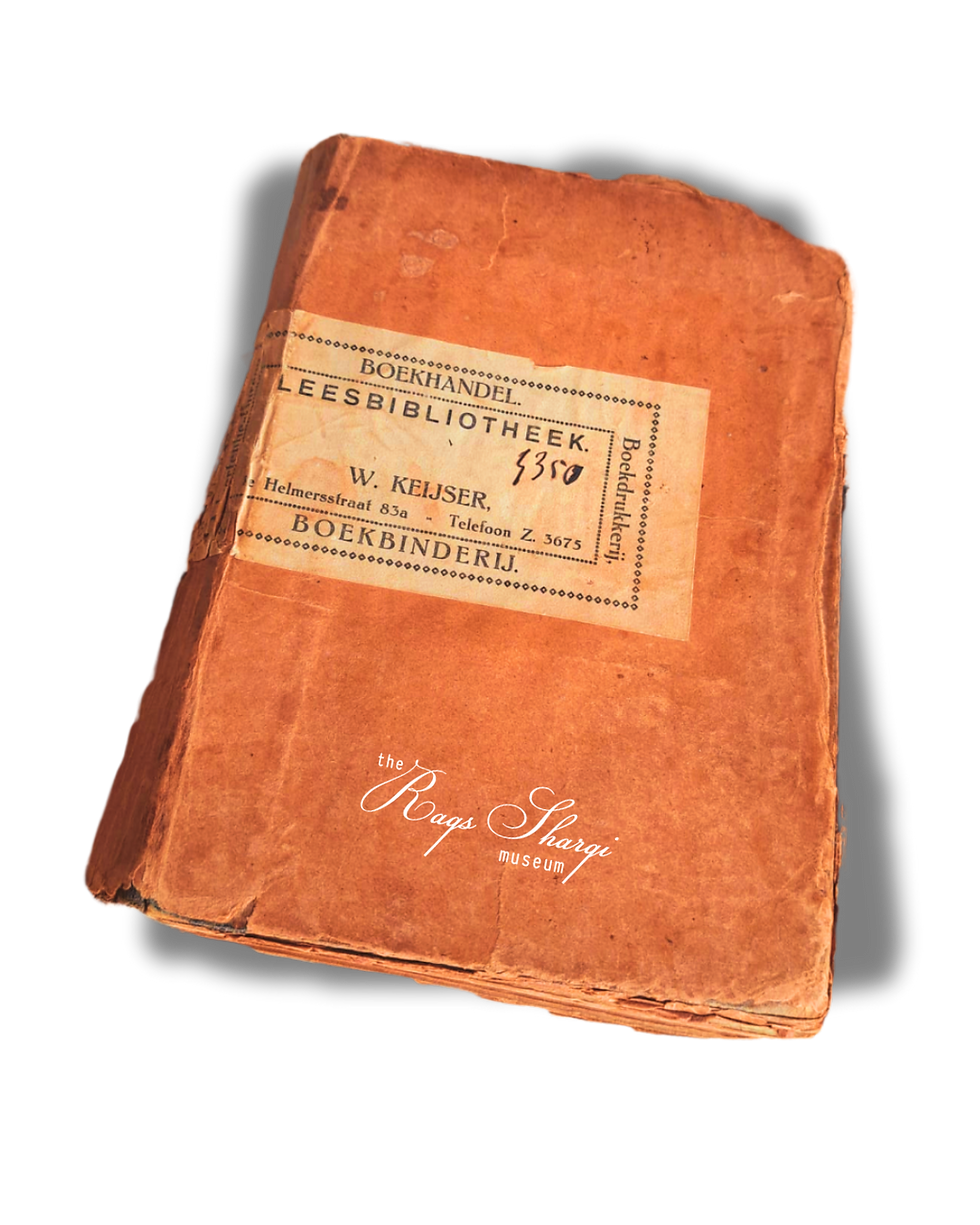
Mata Hari. My Daughter's Life Story and My Grievances Against Her Former Husband
A. Zelle Czn
Amsterdam, 1906
The full title tells you everything you need to know about what kind of book this is.
Mata Hari was Dutch. She was not Egyptian, she was not a raqs sharqi dancer, and the exotic Oriental identity she performed was entirely constructed — a fantasy built on Western imagination rather than on any actual Eastern tradition. She was executed as a spy in 1917, and her name has never really gone away.
This book was written by her father, Adam Zelle, in 1906 — while she was still alive, and apparently without her knowledge. It is a defence, partly based on letters and documents she had sent him, and it is shaped entirely by his perspective: his indignation at her former husband, his desire to protect her reputation, his framing of her life as a moral warning to young women standing "on the threshold of marriage." He describes himself as a lion watching his young being carried off and torn apart by tigers.
I include it in the collection because her story is inseparable from the story of how Western audiences imagined "Oriental" and "Exotic" dance. The fantasy that Mata Hari performed — the veiled, dangerous, unknowable woman of the "Orient"— ran directly alongside, and directly interfered with, how real dancers of the culture were seen and judged by Western eyes. Understanding the distortion helps you see what was being distorted.

These six books are part of the Raqs Sharqi Museum's growing reference collection. If you want to support my time&energy&financial-heavy work, I would be beyond grateful. You can do so on Patreon, where I share the ongoing work: www.patreon.com/raqssharqimuseum. THANK YOU!


Just a couple of notes on the Auriant. I have a copy and translated it into English a few years ago for interested dance friends. Auriant grew up in Alexandria and was used to seeing dancers as a boy and young man. There are two versions of the book - the first has a couple of errors in the story of Kuchuk Hanem which are corrected with apology in the second. It you want a copy, it's often cheaper to buy an original paperback copy and then have it properly bound. JHM